


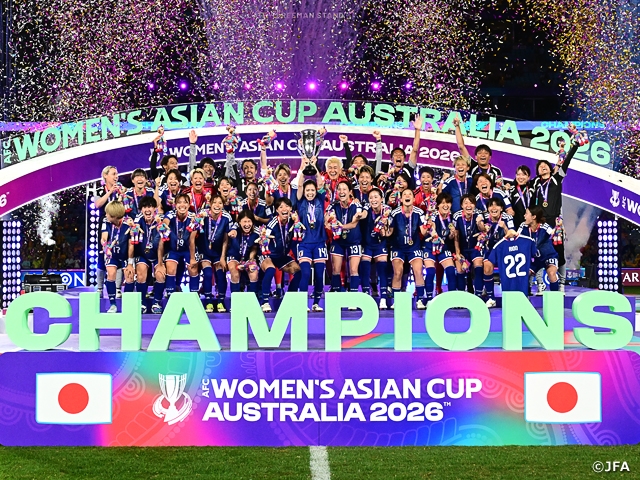
Japan has once again proven why they are Asia’s powerhouse in women’s football, securing a hard-fought 1-0 victory over Australia at Stadium Australia in Sydney to claim their third Women’s Asian Cup title in four editions.
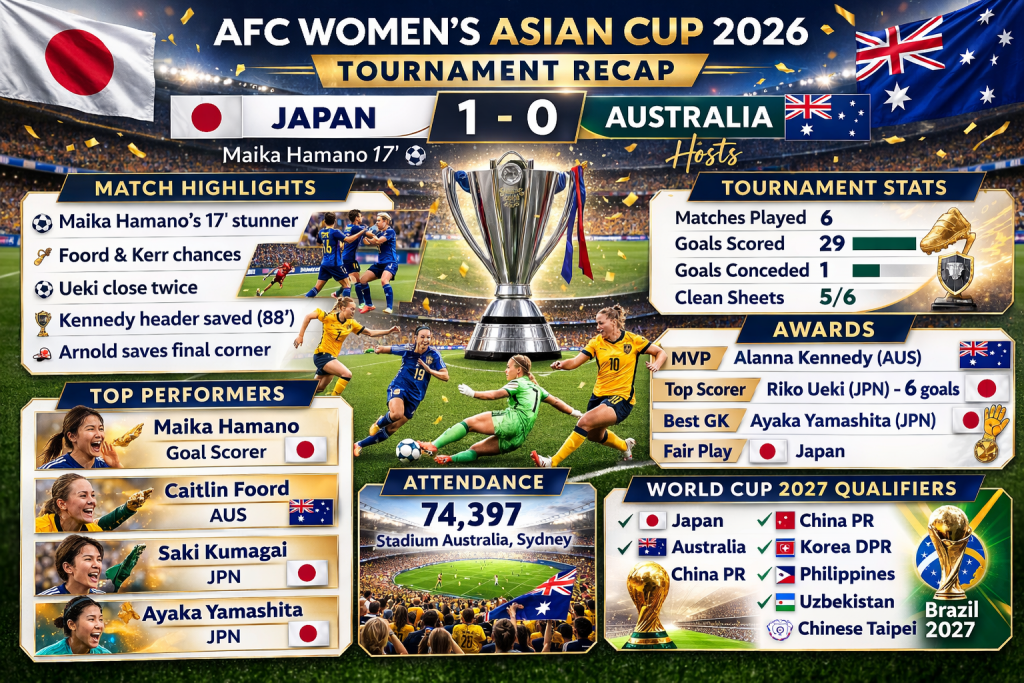
The decisive moment came early, when 21-year-old Maika Hamano, on loan at Tottenham Hotspur from Chelsea, curled a superb strike into the bottom corner in the 17th minute, after receiving the ball on the left and turning sharply to shoot from distance.
Fast Start, Fine Margins, and a Moment of Magic
Australia’s Matildas came out strong, energised by a record 74,397-strong crowd and the roar of their home support.
Mary Fowler’s creativity in midfield, combined with the pace and movement of Caitlin Foord and Sam Kerr, produced several early opportunities.
Foord narrowly missed a clear chance in the 10th minute before Japan struck, with Hamano ghosting past Alanna Kennedy to finish with precision, capitalising on a rare defensive lapse.
Despite going behind, Australia remained dangerous, using their speed and physicality to test Japan’s normally composed side.
Late in the first half, Foord almost converted after a slip from Toko Koga, while Hinata Miyazawa’s cross-field delivery was cut out by Kyra Cooney-Cross, showing how tightly contested the match was.
Pressure Mounts, But Japan Refuse to Bend
The second half saw Australia push harder, with Fowler’s runs and dangerous deliveries into the box keeping Japan on alert.
Riko Ueki, the tournament’s top scorer with six goals, had a couple of strong opportunities, one from a deep cross and another from a through-ball by captain Yui Hasegawa, but both efforts were denied by Mackenzie Arnold or narrowly missed.
Manager Joe Montemurro made tactical substitutions, introducing Hayley Raso for Katrina Gorry and later Emily van Egmond and Clare Wheeler for Fowler and Cooney-Cross.
Even with relentless late pressure, including Kennedy’s 88th-minute header and a final stoppage-time corner with goalkeeper Arnold pushing forward, Japan’s defence remained unbroken.
Veteran Saki Kumagai combined seamlessly with young talent Toko Koga, while goalkeeper Ayaka Yamashita produced key saves to preserve the clean sheet.
Japan continued to control large spells after taking the lead, pushing high, working the ball in tight spaces and showing patience in possession.
Australia, meanwhile, relied on quick transitions and width, repeatedly targeting the flanks through Foord and Carpenter, but struggled to find a finishing touch despite their sustained pressure late on.
A New Generation Steps Into the Spotlight
Beyond the final itself, the tournament highlighted the growing depth of talent across the continent.
Japan’s Toko Koga emerged as a standout at the heart of defence, while Philippines winger Jael Guy, China’s midfield controller Wang Aifang, and Korea DPR’s creative force Kim Song-Gyong all impressed during what remains the early stages of their international careers.
The competition also reinforced the strength of East Asian nations, with five reaching the quarter-finals.
Southeast Asia, represented by Australia and the Philippines, and Central Asia, through Uzbekistan, also made their presence felt in the latter stages.
The Road to Brazil Takes Shape
Japan’s triumph sealed their place at the FIFA Women’s World Cup 2027 in Brazil, alongside the other semi-finalists and two play-off winners, with Chinese Taipei and Uzbekistan progressing to the next stage.
In total, six teams from the tournament have secured qualification, with the remaining spots to be decided through the Play-Off Tournament.
That play-off competition will take place in two phases, beginning in November and December 2026, with six teams from AFC, CAF, CONMEBOL and OFC.
Two sides will progress to a final phase in February 2027, where they will be joined by teams from Concacaf, CONMEBOL and UEFA. From there, three final World Cup places will be decided via knockout matches.
What This Result Means
Japan’s 1-0 victory over Australia was built on composure, discipline and a moment of quality from Maika Hamano that ultimately proved decisive.
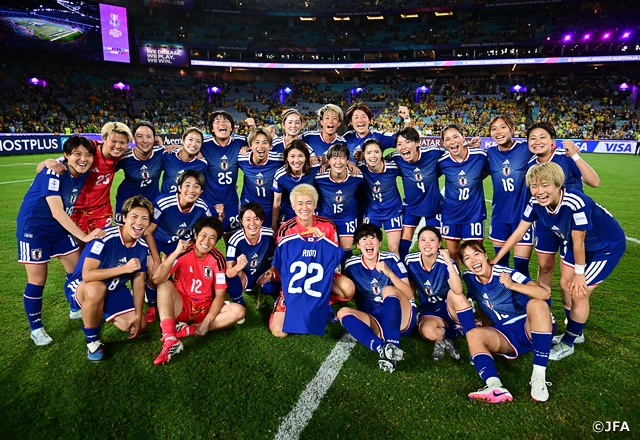
Their run—six wins from six, 29 goals scored, and just one conceded underlines their dominance and positions them as serious contenders on the global stage ahead of the FIFA Women’s World Cup 2027.
For Australia, the performance showed promise and resilience, but their wait for a first Women’s Asian Cup title since 2010 goes on, despite pushing Japan all the way in front of a record home crowd.