
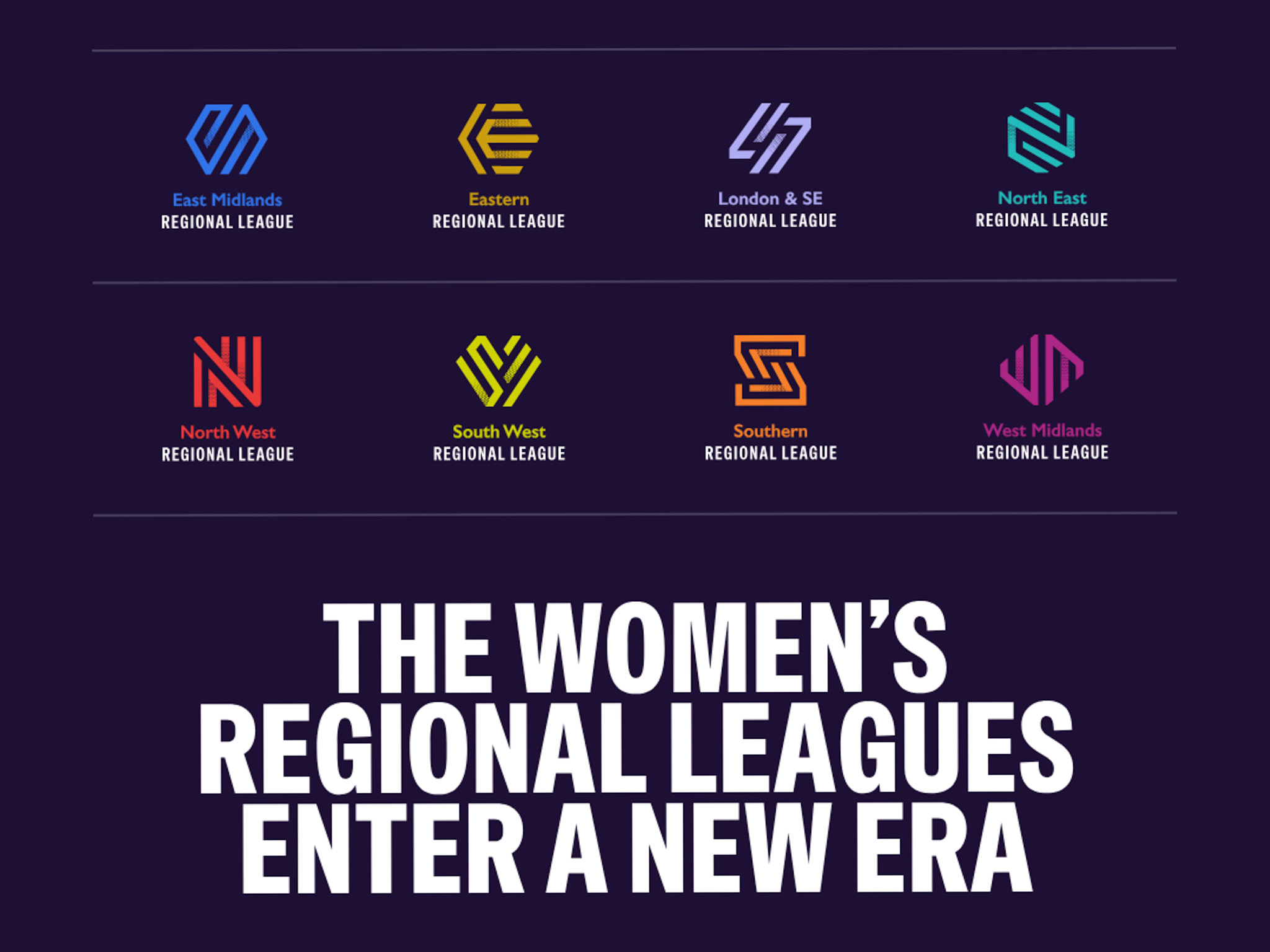
The Women’s Regional Leagues — Tiers 5 and 6 of the women’s football pyramid — have officially launched a new brand identity, marking the beginning of an exciting new chapter for the competition.
For the first time, all eight regional leagues will be united under one shared identity, bringing together the North East, North West, West Midlands, East Midlands, Eastern, Southern, South West and London & South East regions under one collective ambition.
The new identity has been shaped by the people at the heart of the game. Through consultation with players, coaches and members of the wider football community, a clear message emerged: the Women’s Regional Leagues are ready to enter a more professional, recognisable and connected era, while continuing to celebrate the unique communities that make each region special.
The refreshed brand reflects the continued growth of the women’s game and provides a stronger, more consistent identity across the regional leagues as they continue to develop both on and off the pitch.
A national pyramid only really works when there is a degree of consistency between its levels. For too long, the regional leagues operating beneath the FA Women’s National League have often felt fragmented, with different identities, structures and approaches making the lower levels of the pyramid difficult to navigate and, at times, difficult to understand.
Hopefully, this new approach will create a much stronger sense that clubs competing at Tiers 5 and 6 are part of the same overall competition structure as those at Tier 4, Tier 3 and beyond.
That’s particularly important as the women’s game continues to professionalise.
Many of the clubs at these levels remain heavily reliant on volunteers, who give up huge amounts of their time to keep their teams running. Yet there is an increasing expectation — and rightly so — that clubs at every level should be provided with the resources, support and respect needed to develop.
These aren’t clubs content to simply exist at their current level. Many have ambitions to climb the pyramid, and the infrastructure around them should help facilitate that ambition.
Bringing the leagues together under one banner provides an opportunity to go much further with consistency across areas such as,
- Competition rules
- Promotion and relegation criteria
- Ground standards
- Administration
- Communications
- Branding
- Disciplinary processes
- Fixture management
- League data and statistics
That doesn’t mean every region needs to operate identically. Regional football should remain regional. The geographical and logistical challenges facing a club in Cornwall are very different to those facing a club in London, and that regional flexibility remains important.
But the framework surrounding those competitions can, and should, be much more consistent.
For example, it still baffles me that the Southern Region Women’s Football League continues to release fixtures on a month-by-month basis. For club staff, players, volunteers and supporters trying to plan their lives around football, that can create a completely unnecessary headache.
The new branding alone won’t transform Tiers 5 and 6, and I certainly wouldn’t suggest that everything is suddenly fixed.
The real test will be what comes next. If the new identity is used as a foundation for genuinely improving and standardising the experience of clubs, rather than simply placing the same logo across eight competitions, then this could prove to be a significant step forward.
The women’s football pyramid has spent years becoming increasingly professional at the top, but that progress needs to filter down through every level.
Bringing Tiers 5 and 6 together under one identity sends an important message, that the women’s pyramid isn’t just the WSL and the FA Women’s National League. The regional game is an integral part of it too.
And if we want the women’s game to continue growing sustainably, those foundations matter just as much as what happens at the top.